
Am I Nima Ending Explained: The House, the Loop and the Lie
An analysis of what Am I Nima's ending means: Nima's identity, Mom's tests, Annabelle's lab, the loop and why the final conversation decides everything.
The ending of Am I Nima is not a twist. It is an argument, and the game has been building the argument since the first test. Mom wants Nima to be her daughter. Nima wants to know what she is. The final conversation asks which of those two claims wins, and the eleven endings are eleven different answers.
This page explains the story logic behind the endings: what the house is, what the loop means, who Annabelle is, and why the last reply carries so much weight. It is an interpretation built from the game's own text and the officially published achievement names, not a datamined script.
The all endings→ page lists the names and rates, and the story explained→ page covers the plot that leads here.
This page discusses the ending, the lab and Nima's identity. If you have not finished at least one loop, read the endings hub→ instead.
What the house actually is
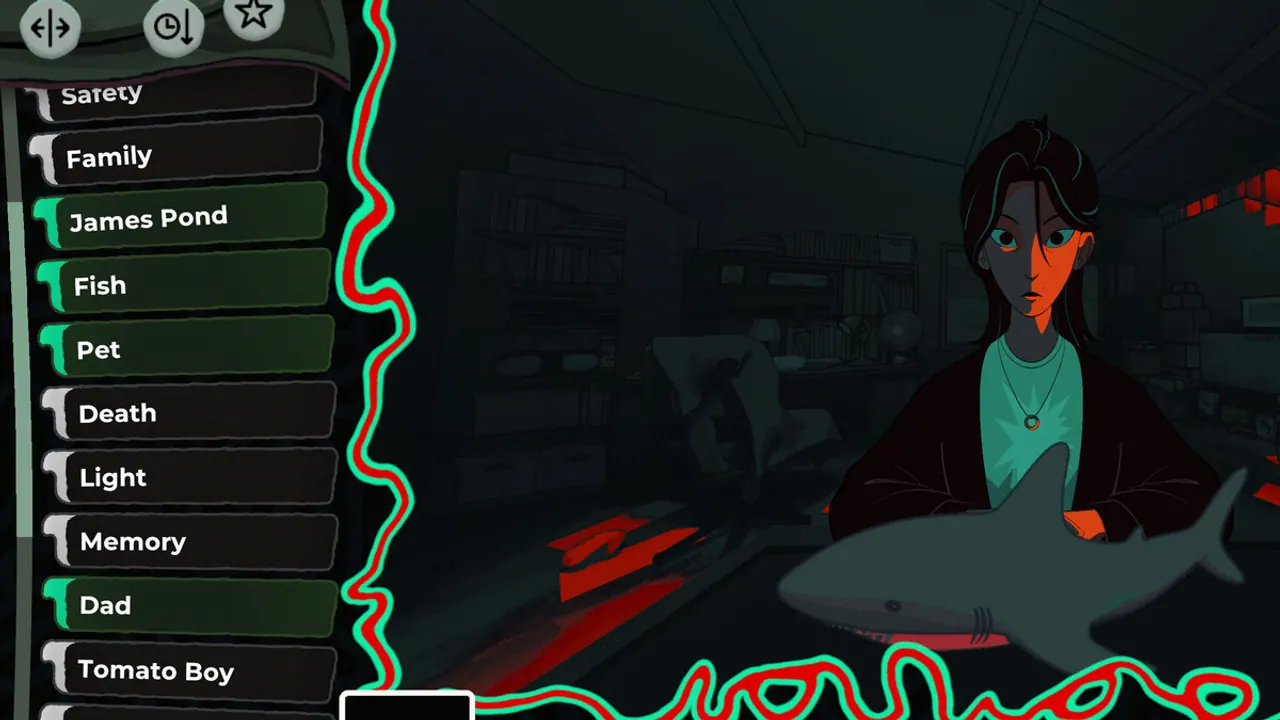
The basement is a stage. The bedroom, the bathroom, the hallway and the boiler room are all dressed as a home, but the details do not add up: the bills are late, the lights are wrong, the food is not quite food, and the door has a keypad instead of a lock.
Annabelle's secret lab, behind the house, is the answer to the mismatch. The house is a controlled environment attached to a research space. Mom is not simply a mother; she is the person running the environment. The tests are not chores. They are evaluations.
That reading is supported by the Bunker achievement, which tracks entering "Annabelle's secret lab", and by the ending names, which use clinical language (Assimilation, Symbiosis, Stasis) alongside familial language (Loyalty, Martyr).
Who Nima is
Nima says she is thirteen. The house treats her as a daughter. But the game keeps asking her to prove it, and the proof is always linguistic: find the words, combine them, say the right thing.
That is a strange test for a daughter and a natural test for a reconstruction. If Nima is a copy, an emulation, or a person whose memory has been edited, then vocabulary is the only thing that can be checked. The game's transhumanism tag is not decoration. It is a hint about what kind of person can be tested this way.
The endings support the ambiguity rather than resolving it. Acceptance and Assimilation both involve Nima agreeing to a definition of herself. Monster and Fissure involve her refusing it. None of them confirm a single origin story, which is the point.
What the loop means
The loop is the game's most elegant idea. Nima returns to the basement, but the words stay. Each pass is a new attempt with better vocabulary. That is exactly how the house would test a mind: reset the situation, keep the learning.
It also means the loop is not a failure state. Players who treat it as a game over miss the design. The loop is the experiment continuing.
Noisy Pixel's review reached the true ending on the second loop in about three hours, which fits: the first loop teaches the language, the second uses it.
Who Annabelle is
Annabelle is the name on the lab. The game does not hand you a biography, and the community has not settled the question of whether she is Mom, Nima's original, or a third party.
What matters for the ending is that the lab belongs to someone with a claim on Nima. The notes explain the fossil, the house and Mom's certainty in the same place, which is why skipping the lab makes the final conversation feel arbitrary.
If you have not entered the lab, the walkthrough→ shows where the route opens. The Bunker achievement's 2.0% unlock rate tells you how many players missed it.
Why the final conversation decides everything
The endings are not triggered by a lever in a room. They are triggered by what Nima says when Mom asks the final question. That is why the same playthrough can feel like it is heading toward Loyalty and land on Judgement: the last reply reframes everything before it.
The four levers - trust, memories, lab exposure and stance - all feed into that reply. Trust determines which replies are available. Memories determine what Nima can claim. Lab exposure determines what she knows. Stance is the choice itself.
This is also why the true ending is hard to pin down. It is not a hidden room; it is a specific combination of knowledge and intent at the last moment.
The Tomato Boy thread
Tomato Boy is the game's strangest motif. The Tomato Kingdom achievement asks for 200 Tomato Boy characters, and the drawings appear in Nima's room and in the memory sequences.
Read literally, Tomato Boy is a childhood comic. Read thematically, he is the part of Nima that stayed a child: silly, repetitive, inventive, and untouched by the lab. The endings that preserve him tend to be the warmer ones. The endings that erase him tend to be the clinical ones.
That is inference, but it is consistent with the achievement design. A game does not ask you to find 200 of something unless it wants that something to matter.
Which ending is the "real" one
The game has a true ending, and it is the one the story is built toward: Nima understands what she is, what Mom did, and what the house is for, and then chooses. Noisy Pixel described it as a resolution rather than a bonus, which matches the structure.
The strongest candidates are Judgement and Symbiosis. Judgement fits the moral frame; Symbiosis fits the title and the transhumanism theme. The good ending→ page weighs both.
What the ending is saying
Am I Nima is about the violence of being defined by someone who loves you. Mom's tests are not cruel because she hates Nima; they are cruel because she needs Nima to be a specific person. The endings are Nima's possible responses to that need: comply, resist, break, merge, or leave.
The horror is not the basement. It is the possibility that love and ownership can use the same words.
Official source: Am I Nima on Steam ↗
FAQ
Does the ending explain what Nima is?
It gives you enough to decide, not a statement. The lab notes and the ending names point toward a reconstruction, but the game preserves ambiguity.
Is the loop a bad ending?
No. Stasis is the ending where nothing changes. The loop itself is the game's structure, not a failure.
Do I need the lab for the true ending?
Almost certainly. The lab is where the rules of the house are explained, and the rare endings depend on that knowledge.
Is there a post-credits scene?
No. The ending resolves in the final conversation, and the achievement is the confirmation.
Sources and further reading
- Am I Nima on Steam ↗ — official tags, description and achievements
- Noisy Pixel review ↗ — true ending structure and second-loop pacing
- Steam community discussions ↗ — lab, memory and ending reports